

What is Curling?
 Curling is a sport in which players slide stones on a sheet of ice towards a target area, which is segmented into concentric rings.
Two teams, each of four players, take turns sliding heavy, polished granite stones, also called rocks, across the ice (curling sheet) towards the house, a circular target marked on the ice.
Each team has eight stones and the purpose is to accumulate the highest score for a game; points are scored for the stones resting closest to the centre of the house at the conclusion of each end, which is completed when both teams have thrown all of their stones.
The playing positions on each team are commonly known as Lead, Second, Third, and Forth. The lead is the player who delivers the first two stones, with the second playing the third and forth stones, and so on. The team appoints a Skip, or team captain, and a Vice-Skip, with these individuals usually throwing Forth and Third, respecitively.
The role of the skip is to direct play for the team, and they are found standing in the house at the scoring end of the sheet to mark each shot with their broom. The vice-skip takes over the skip's duties for the team when the skip is delivering their stones.
History of Curling
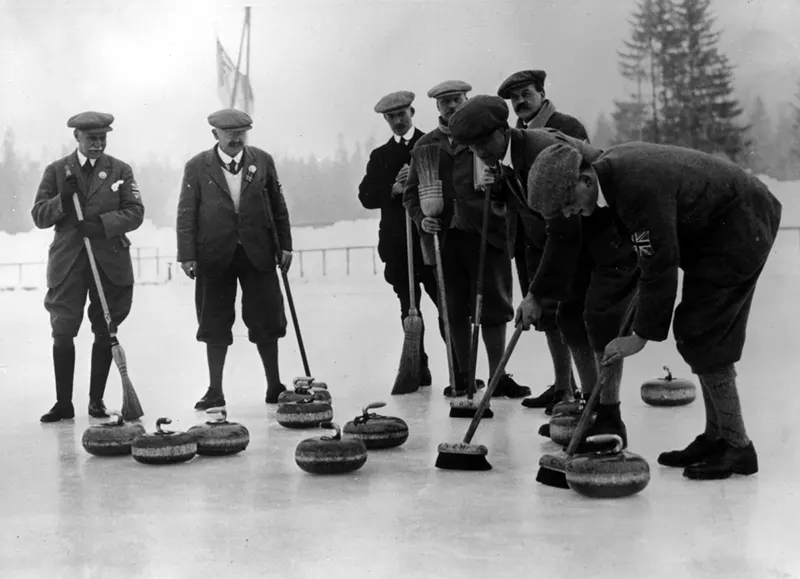 While curling first became a regular occurance in the 1998 Winter Olympics, it has been played in Scottland since the 16th century where it was played on frozen lochs and ponds. The first recorded curling match comes from 1540, when John Sclater, a Scottish monk from the Paisley Abbey, challenged the lay governor of the abbey, Gavin Hamilton, to a curling match.
Originally, curling was played with stones pulled from creek beds that, when slid across the ice, would curve, or "curl," hence the name of the sport. Handles were added later to better help with delivery, and brooms were originally used to sweep the ice of debris to help the stone move along.
Today, curling stones are all made from granite from only two quarries in the whole world - in Scotland and Whales. Stones are made from three types of quartz-free granite: Blue Hone, Alisa Craig Common Green, both found on Ailsa Craig island, and Trefor, which can be found in the Trefor quarry of Wales. Curling brooms have also modernized, changing from corn or hog hair to synthetic materials with a fabric pad and a fiberglass or carbon fiber handle.
Curling spread to North America in the late 1700's from Scottish soldiers and emigrants, with the first document record as the founding of the Montreal Curling Club in 1807. In 1832, the Orchard Lake Curling Club, near Detroit, became the first curling club in the United States. Curling grew since this time in the United States until the United States Curling Associate (USCA) was founded in 1958.
Spirit of Curling
The St. Louis Curling Club works to preserve and promote the Spirit of Curling, a commonly used term in the sport. It refers to the respect curlers show, not only to one another, but also to the sport itself.
Curling is a game of skill and traditions. A shot well executed is a delight to see and so, too, it is a fine thing to observe the time-honored traditions of curling being applied in the true spirit of the game. Curlers play to win but never to humble their opponents. A true curler would prefer to lose rather than win unfairly.
A good curler never attempts to distract an opponent or otherwise prevent another curler from playing his or her best.
No curler ever deliberately breaks a rule of the game or any of its traditions. But, if a curler should do so inadvertently and be aware of it, he or she is the first to divulge the breach.
While the main objective of the game is to determine the relative skills of the players, the spirit of the game demands good sportsmanship, kindly feeling and honorable conduct. This spirit should influence both the interpretation and application of the rules of the game and also the conduct of all participants on and off the ice.
Basics of the Game
What is this game of rocks and brooms all about? Curling is a sport in which two teams of four players each slide (called throwing) 40-pound granite rocks (also called stones) down a sheet of ice toward a target at the other end. Each team tries to get more of its stones closer to the center of the target than the other team. Read on for a complete breakdown of curling’s basic elements.
- Throwing rocks: Each player on the team throws (slides) two stones in each end. (An end is similar to an inning in baseball.) Each team throws 8 stones in an end. The players alternate throwing with their opposite number, the player on the other team who plays the same position they do.
- Curling rocks: When you throw a rock down the ice, depending on its rotation — which is applied intentionally — it will curl, or bend, one way or another. How much (or little) a rock curls or bends, depends largely on the conditions of the playing surface.
- Sweeping: Sweeping makes a rock curl less and travel farther. The lead, second, and third all take turns sweeping the rocks. The skip, who is like the team’s quarterback, is the only one who doesn’t regularly sweep stones.
- Keeping score: Once all 16 rocks have been thrown down the narrow sheet of ice, the score for that end is counted based on the final positions of the stones in the house, (the group of circles on the ice that looks like a bull’s eye). Only one team can score in an end. A team scores one point for every rock that it has closer to the center of the house than the other team.
- Strategy: Generally, the skip determines a team’s strategy. During the game, the skip stands at one end of the sheet and tells his or her other three players where they should place their shots. A team’s strategy doesn’t always go according to plan! And that’s part of what makes curling so much fun. No two games are alike; the unpredictability is always appealing.
Team Positions
In curling, the team is made up of four players: the lead, the second, the third (also called the vice, vice-skip, or mate), and the skip.
Each player has specific duties:
- Lead: The lead throws the first two rocks of the end and then sweeps the next six. The lead must be very good at throwing guards and a strong sweeper.
- Second: The second throws the third and fourth stones of the end and should be strong at playing takeouts. The second sweeps the first two stones and then the final four of the end. The second and the lead need to be in sync when sweeping together.
- Third: The third (or mate or vice), who throws the fifth and sixth rocks of the end, must be good at all shots, but especially draws. It is the third’s job to set up the shots that will be thrown by the skip, and to help the skip discuss the strategy of the final two stones of the end. The third also posts the score at the conclusion of the end.
- Skip: The skip is the captain of the team and decides the strategy. It’s the skip’s job to tell the other players where to throw their shots and when to sweep. The skip also delivers the last two shots of the end. The skip must be good at all types of shots.
The Vice and Skip don't necessarily need to throw later in the order, but they typically do since those are the players with more experience.

Curling Etiquette
Start with a handshake. At the beginning of the game, greet the members of the opposing team with a handshake, tell them your name, and wish them “Good Curling”.
Finish with a handshake. When the game is over, offer each of the players a hearty handshake and move off the ice. The winning curlers traditionally offer their counterparts some refreshments and partake in "broomstacking."
Keep the ice clean. Change your shoes. Sand, grit and dirt are the ice’s worst enemy. The shoes you wear should only be used for curling. Keep them clean.
Compliment good shots, no matter which team makes them. Respect your opponent.
Be ready. Take your position in the hack as soon as your opponent has delivered his/her stone. Keep the game moving; delays detract from the sport.
Be prepared to sweep as soon as your teammate releases the rock.
After delivering your stone, move to the side of the sheet between the “hog “ lines, unless you are the skip. Leads and seconds are not permitted in “house” or “rings”, except when sweeping or to remove the stones after the count has been determined by the vices.
Be courteous. Don’t distract your opponent in the hack. Sweepers should stay on the sidelines between the hog lines when not sweeping.
Place your skip’s rock in front of the hack to help speed up the game.
All games on the ice should run approximately the same time. Therefore, if your game is an end or two behind all other games you should pick up the pace. Each player should be ready to deliver their rock when their skip puts down the broom.
Doubles Curling
Setup
Before the first stone is thrown, the end begins with one stone in the house and another stone places as a guard following the rules below.
Regular End
Team with hammer - Place a stone in the back of the 4 ft. ring
Team throwing first - The position of the guard is agreed on by the teams before the start of the game. Legal placements can be seen in the diagram below.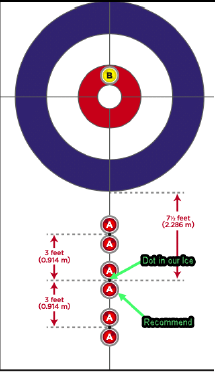
Power Play
Each team can elect to use 1 power play per game. This must be used when you have hammer.
Team with hammer - Place a stone just above the tee line bisecting the 8 ft. circle on either side of the house
Team throwing first - Place a stone on an imaginary line from the center of the hack to the set stone in the house, directly horizontal from the agreed upon standard position.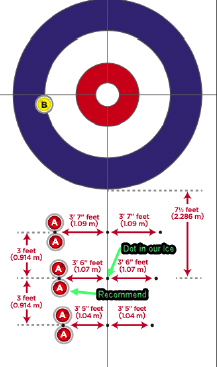
Order of Play
- Teams alternate throwing stones just as a normal game.
- Each team throws 5 stones per end.
- One team meber throws the 1st and 5th stones.
- The second team member throws 2nd, 3rd, and 4th stones.
- The team meber who throws 1st and 5th can alternate between ends.
Modified Free Guard Zone
- NO stone in play can be removed from play prior to the 4th thrown stone.
- This includes all stones in the guard zone AND in the house.
- This includes your own stones.
- This includes the set stones.
- If there is a violation, the thrown stone is removed from play and all displaced stones are reset to their initial position.
Scoring
- Doubles scoring is the same as a regular 4-person game.
- In the event of a blank end, the hammer in the next end goes to the team who threw first in the blanked end.
Sweeping and Aiming
- After delivery, either or both players may sweep their delivered stone or any of their own stones which are disturbed before the tee line.
- Once a stone crosses the tee line, only one player from each team is allowed to sweep. They may sweep their own or their opponent's stone(s).
- The non-delivering player on the team can either hold a broom for the delivering player, or be prepared to sweep after release.
- If you wish to have something to aim at, but would prefer the non-delivering player to sweep, feel free to set up a few cones behind the house as reference points.
Curling Terms
Backline
- The line across the ice at the back of the house. Stones which are over this line are removed from play.
- Biter
- A stone that just touches the outer edge of the circles and is considered in the house.
- Blank End
- An end in which no points have been scored.
- Board Weight
- Throwing a stone with enough speed that it will come to rest in an area just behind the hacks – about 6 feet behind the house. Synonymous with barrier/bumper weight.
- Bonspiels
- Curling tournaments that usually occur over a weekend.
- Broom/Brush
- The instrument used to sweep the ice. Brooms with brush heads are most common.
- Burned Stone
- A stone in motion touched by a member of either team, or any part of their equipment. Burned stones are removed from play.
- Button
- The circle at the center of the house.
- Control Weight
- A takeout shot that is slow enough that the sweepers have relative control over its curl; faster than board weight, but slower than normal takeout weight
- Counter
- Any stone in the rings or touching the rings which is a potential point.
- Curl
- A twist of the stone's handle upon release makes the stone curl, or curve, as it travels down the ice. The rock curls in the direction of the turn. The amount a rock bends while travelling down the sheet of ice.
- Delivery
- The body motion of a curler as the rock is being shot.
- Draw/Draw Weight
- The momentum required for a stone to reach the house or cirles at the distant end. Rock that stops in front of or in the house.
- End
- Similar to an inning in baseball. One end is complete when all 16 rocks (eight per team) have been thrown to one end. A game is usually eight ends, or about two hours. Championship games are 10 ends, or about 2 1/2 hours. After each end, the score is determined.
- Freeze
- A draw that finishes in front of and next to another rock.
- Front Ring
- Diameter of 12-foot circle in front of the tee line.
- Guard
- A stone that is placed in a position so that it may protect another stone, usually a rock between the hog line and the house used to prevent the opposition from hitting a rock in the house.
- Hack
- A rubber foothold from which curlers deliver the rock. It is about 125 feet from the scoring area.
- Hack Weight
- The weight required to deliver a stone in order that it travels to the hack at the far end.
- Hammer
- The last rock of each end.
- Heavy Weight
- A rock delivered with a greater force than necessary.
- Heavy Ice
- When the ice is "slow" and the rocks have to be thrown harder.
- Hit
- A take-out. Removal of a stone from the playing area by hitting it with another stone.
- Hog Lines
- Located 21 feet from each tee. A rock must be released before the near hog line, and travel beyond the far hog line, or it is removed from play.
- Hogged Stone
- A stone that does not reach the far hog line. It must be removed from play.
- House
- The scoring area, the rings or circles toward which play is directed consisting of a 12-foot ring, 8-foot ring, 4-foot ring and a button.
- Hurry
- A command shouted by the skip or shooter to tell the sweepers to sweep.
- In-Turn
- The rotation applied to the handle of a stone that causes it to rotate in a clockwise direction and curl for a right-handed curler.
- Keen Ice
- When the ice is "fast" and less momentum is needed to get the rock to the desired target.
- Lead
- The player who delivers the first two rocks of each end, alternating with the opponent's lead.
- Narrow
- A rock delivered inside the intended line of delivery.
- Normal Weight
- Normal takeout weight; faster than control weight, but slower than peel
- Out-Turn
- The rotation applied to the handle of a stone that causes it to turn and curl in a counter-clockwise direction for a right-handed curler.
- Pebble
- Small droplets of water intentionally sprayed on the ice that cause irregularities on the surface, allowing the rocks to curl. Also a verb; the action of depositing water droplets on the ice, as "to pebble the ice between games"
- Peel Weight
- A stone delivered with a heavy takeout weight
- Raise
- A draw that raises, or moves/bumps, another rock into the house.
- Rocks
- Also known as stones, curling rocks are made of rare, dense, and polished granite quarried only on Ailsa Craig, an island off Scotland's coast. Each piece of granite is carefully machined and balanced, and a goose-neck handle is added for the player's convenience. The result is a standard 42 to 44 pound rock, with a diameter of one foot, and a height of 4.5 inches, not including the handle.
- Roll
- The movement of a curling stone after it has struck a stationary stone in play.
- Scoring
- Only one team scores per end, that being the team with the rock closest to the center of the house. Points are awarded for each rock closer to the center than the opponent's. The maximum score in an end is eight, which is very rare. Typically one to three points are scored per end. The team with the highest total at game's end is the winner.
- Second
- The player who delivers the second two rocks of each end for their team, alternating with the opponent's second.
- Sheet
- The 146-150 foot long and 14.5-16.5 foot wide ice playing area. The sheet's design allows play in both directions.
- Shot Rock
- At any time during an end, the stone closest to the button.
- Skip
- The player who holds the broom as a target for shots by the other three players. Skips are also the team strategists and must study, or read, the ice; anticipate the amount of curl, and then call the shots. Skips usually throw the last two rocks of each end.
- Slider
- Worn over the shoe on the sliding foot in the delivery of a stone to allow for a long, smooth motion and follow through. Specially-made curling shoes have sliders built in.
- Straight Ice
- When the ice conditions do not allow the stones to curl much.
- Sweeping
- The action of moving a broom or brush back and forth in the path of a moving stone. Players sweep to make the rock travel farther or to keep it from curling more than desired. Good sweepers can increase the distance a stone travels by as much as 15 feet. Sweeping creates a thin film of water under the rock, allowing it to glide easier.
- "Swingy" Ice
- When ice conditions cause stones to curl greatly.
- Takeout
- Removal of a stone from the playing area by hitting it with another stone.
- Teams
- A curling team, which consists of four players: the skip, third (or vice skip), second and lead. All players are involved in every shot, with one shooting (delivery the stone), two sweeping, and one calling strategy. Two teams play against each other.
- Tee Line
- The line that passes through the center of the house parallel to the hog line and backline.
- Third
- The player who delivers the third's two rocks of each end, alternating with the opponent's third. Also known as the vice skip, this player holds the broom, or target, when the skip shoots, and also helps the skip with game strategy.
- Wide
- A rock delivered outside the target line.
- Weight
- The amount of force given to the stone during the delivery.